Local-first · US-align powered
See where the
assembly moves.
Two structures become an auditable chain map, contact-change view, motion decomposition, spatial difference patches, and publication-ready card. Different lengths stay visible.
1 transformfor the whole assembly
0 uploadsfor your private structures
10+ exportsfrom one comparison
15-second walkthrough
The whole result,
before you install.
Rotation, mapping, displacement, unmatched chains, exports, and the local command—captured from the same deterministic example data used below.

Complete precomputed example
2HHB T state → 1HHO R state
This intentionally compares a four-chain coordinate model with a two-chain asymmetric unit. The unmatched-chain warning is part of the scientific result, not an error to hide.
Blue is near, red is far · yellow spokes show direction above the adaptive threshold · drag to rotate
Difference localization
Where does the fit diverge?
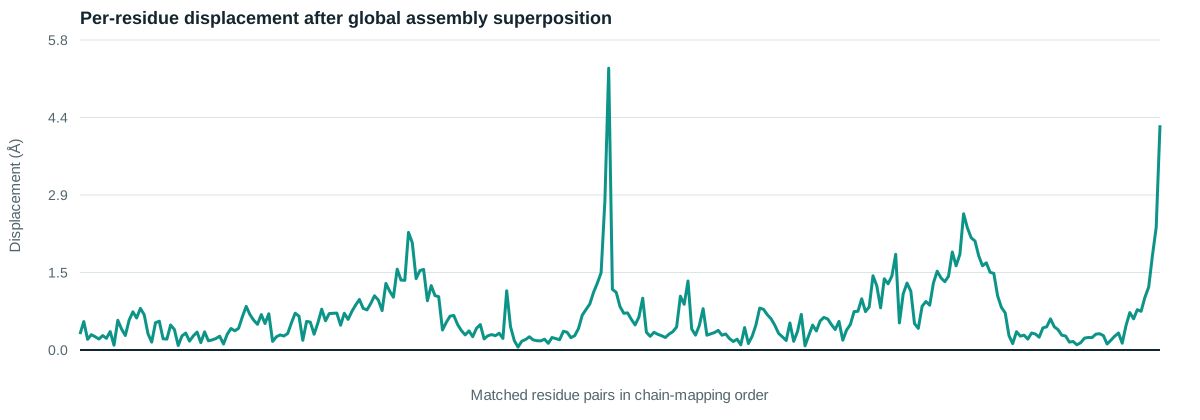
Nearby high-residual residues are grouped into coherent regions and expanded by two residues for context. These are global-fit disagreements, not automatic claims of flexibility.
near · 0 Åfar · ≥5 Å
| # | Chain map | Mobile region | Reference region | Mean | Peak |
|---|
Structural explanation
What changed, and how?
Three complementary views distinguish contact rewiring, whole-chain motion, and spatially connected difference patches. They remain diagnostics of the selected correspondence—not automatic mechanistic claims.
01
Gained / lost contacts
8 Å representative-atom contacts with a 1 Å transition margin.
Gained—
Lost—
Inter-chain—
gained in mobilelost from mobile
02
Rigid-body vs internal
A diagnostic chain-local refit separates pose disagreement from remaining deformation.
| Chain | Rigid | Internal | Pattern |
|---|
03
3D spatial difference patches
High-residual residues within 10 Å are grouped even when they are distant in sequence or cross a chain interface. P labels mark multi-residue patches in the viewer.
| Patch | Members | Chain(s) | Mean | Peak | Spatial radius |
|---|
Coverage audit
Gaps and unmatched chains remain first-class.
matchedonly mobileonly reference
Publication card
One comparison,
ready to share.
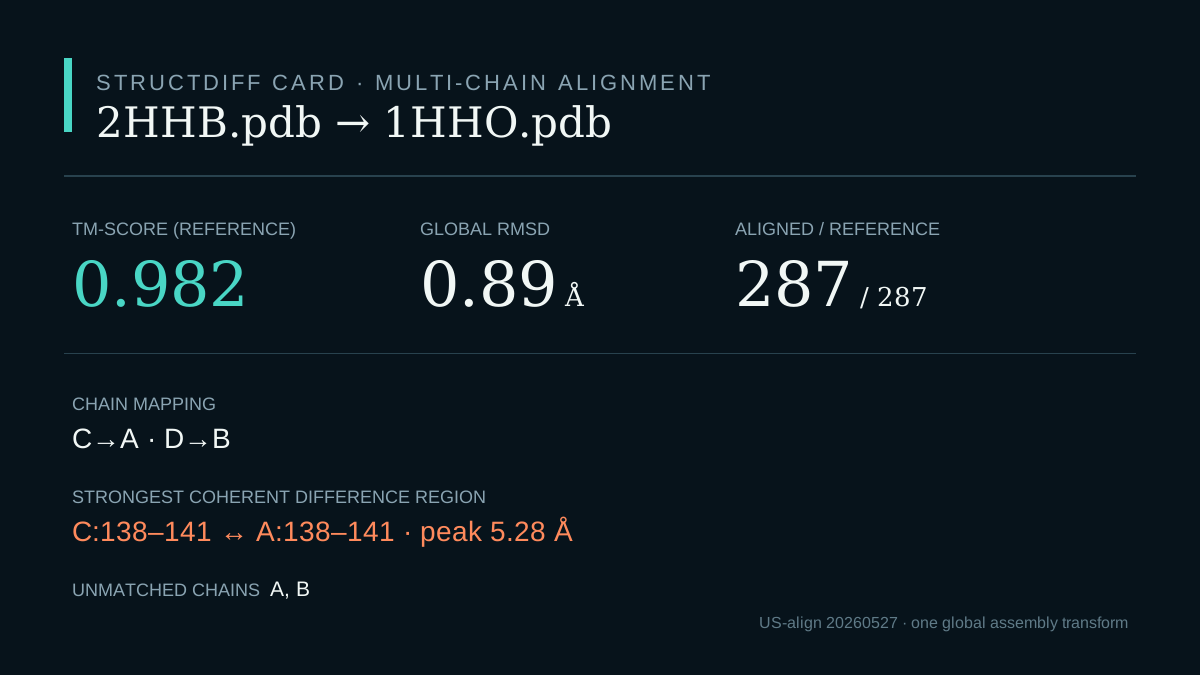
The card carries the score normalization, mapping, largest displacement, unmatched chains, and engine version—context that a lone RMSD screenshot usually loses.
Chain mappingCSV · assignment and coverage↓
Residue mappingCSV · matched and gap rows↓
Difference regionsCSV · coherent hotspot windows↓
Difference summaryJSON · threshold and distribution↓
Contact changesCSV · gained and lost residue pairs↓
Contact summaryJSON · definition and counts↓
Motion decompositionCSV · rigid and internal components↓
Spatial patchesCSV · 3D-connected hotspots↓
Displacement plotSVG · vector export↓
Publication cardSVG · editable vector↓
Reference structurePDB · PyMOL-ready companion↓
Aligned mobilePDB · global transform applied↓
Difference-coded structurePDB · residual stored in B-factor↓
PyMOL viewPML · ready-made difference colors↓
Method
Correspondence before distance.
Kabsch is not the missing piece when residue counts differ. Correspondence is. StructDiff Card delegates structural alignment and chain assignment to US-align, then makes the consequences inspectable.
- 01Parse
Preserve chain IDs and coordinate residue IDs from PDB/mmCIF.
- 02Align
Run monomer or multi-chain US-align with one global transform.
- 03Audit
Expose chain pairs, unmatched chains, gaps, coverage, and provenance.
- 04Explain
Localize residuals, contact changes, chain motion, and 3D patches.
Scope, honestly stated.
Alignment anchors are polymer representative atoms (protein Cα; nucleic-acid C3′). Ligands can move with the global transform but are not treated as equivalent correspondence anchors. Symmetric assemblies can have multiple valid mappings—inspect the table.
Private by default
Run locally in one command.
Your unpublished models stay on your machine. No GPU, API key, or author-operated server is required.
Terminal
docker run --rm -p 8501:8501 ghcr.io/jwliaomath/structdiff-card:latest
Then open http://localhost:8501